

Walk down almost any street in Britain and you’ll notice brickwork patterns staring back at you. From the neat uniform lines of post-war housing estates to the ornate façades of Georgian terraces, the way bricks are laid is rarely random.
These patterns, or bonds, are more than decoration. They’re structural choices that dictate strength, stability, and even the character of a building.
For homeowners, understanding bonds helps identify the era or style of a property. For builders and architects, it’s about safety and practicality as much as appearance.
And for anyone curious about construction, bonds are one of those quiet details that say a lot about how the UK builds.
What Is A Brick Bond?
At its simplest, a brick bond is the pattern in which bricks are laid. But that pattern does a lot of heavy lifting.
It spreads loads evenly, ties walls together, and avoids the weakness of long vertical joints lining up.
Bonds balance two priorities: structural integrity and visual effect. Some are straightforward, designed purely to get a strong wall up quickly. Others are decorative, turning a flat wall into something with rhythm and texture.
Look closely at older UK buildings and you’ll see how bonds often signal the architectural style of the time.
A Victorian warehouse with English bond, a Georgian townhouse with Flemish, or a modern semi with stretcher bond, it’s all written in the brickwork.
Commonly Used Brick Bonds In The UK
Over the centuries, bricklayers have developed many different bonds, header, stack, English garden wall, to name a few. But three dominate UK construction and deserve closer attention:
- Stretcher bond – the workhorse of modern housing.
- English bond – the traditional symbol of strength.
- Flemish bond – the elegant checkerboard of period homes.
Stretcher Bond
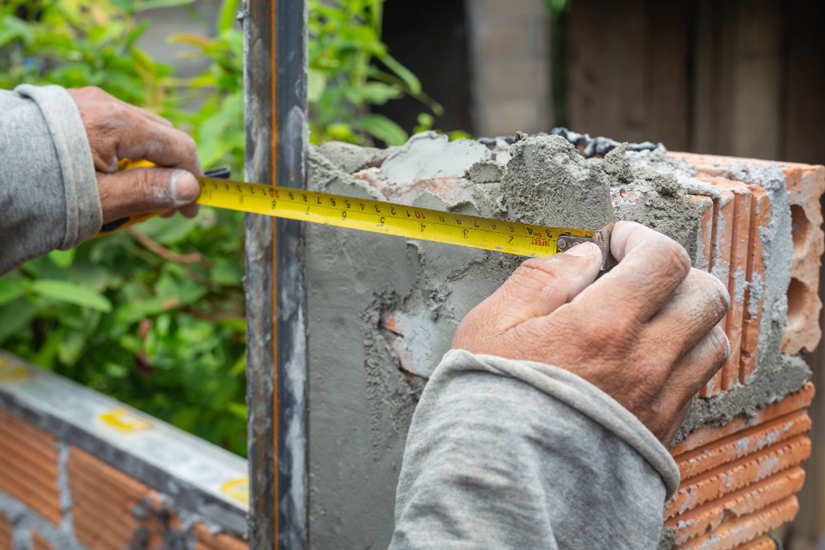
The stretcher bond is probably the pattern most people picture when they think of brickwork. Every brick is laid lengthwise (the stretcher face) with each course overlapping the one below. It’s simple, repetitive, and efficient.
Why’s it so common? Cost and ease. It uses fewer bricks than older bonds and can be laid quickly, which is ideal for large housing developments.
Stretcher bond is the standard for cavity walls, the norm in UK housebuilding since the 20th century. The two leaves of brickwork are tied together with wall ties, so the bond itself doesn’t need to provide massive strength.
That’s also its limitation. On its own, a stretcher bond single-skin wall lacks structural muscle. You wouldn’t use it for a heavy load-bearing boundary wall. But paired with cavity wall construction, it’s more than adequate.
Visually, it’s plain but neat. It suits suburban streets where uniformity is the goal. Think of it as the reliable Ford Fiesta of brick bonds, nothing flashy, but it gets the job done.
English Bond
Step into a Victorian factory or a railway arch, and chances are you’ll be looking at English bond. This pattern alternates courses: one row of headers (the short end of the brick), followed by a row of stretchers.
That alternating rhythm isn’t just for looks. It locks the bricks together, creating what many consider the strongest of all bonds.
The result is a wall with excellent load-bearing capacity, perfect for industrial, institutional, or boundary structures where failure isn’t an option.
English bond does use more bricks than stretcher bond, and it takes more time and skill to lay. That makes it more expensive. But when safety and durability are top priorities, the extra investment pays off.
You’ll see it in old railway bridges, university buildings, and traditional garden walls across Britain. It’s a bond that speaks of solidity. If stretcher bond is practical and plain, English bond is solid and dependable, like an oak beam holding up the roof.
Flemish Bond
The Flemish bond is the showpiece. In this pattern, each course alternates stretcher and header, so you get a checkerboard effect across the wall.
Where the English bond puts function first, the Flemish bond finds a balance between strength and beauty.
It’s a little weaker than English bond structurally, but still robust enough for most domestic and commercial walls.
What really sets it apart is the visual appeal. Georgian and Victorian builders favoured Flemish bond for prestigious housing and civic buildings, where elegance mattered as much as strength.
The downside? Precision. Lay it poorly, and the alternating pattern looks untidy fast. It requires a skilled bricklayer who understands both the maths of spacing and the artistry of alignment.
Today, Flemish bond is still associated with quality. Walk through historic areas of London, Bath, or Edinburgh, and you’ll spot its distinctive pattern on period homes. It’s the brick equivalent of a tailored suit, classic, sharp, and demanding to get right.
Comparing Stretcher, English, And Flemish Bonds

To put it side by side:
- Strength : English bond is the heavyweight, Flemish is solid but slightly weaker, and stretcher relies on cavity wall systems.
- Looks : Flemish is the most decorative, English is strong and traditional, and stretcher is simple and modern.
- Ease of laying : Stretcher is straightforward, English takes more effort, Flemish requires precision and experience.
- Cost : Stretcher is the cheapest and fastest, English and Flemish are more costly in both materials and labour.
The choice often comes down to purpose. New-build housing estates almost always go for stretcher bond.
Heritage restorations or boundary walls lean towards English or Flemish, depending on the style of the original.
Practical Considerations In Choosing A Bond
Deciding which bond to use isn’t just about aesthetics. Builders weigh up:
- Purpose – load-bearing vs. cavity wall vs. decorative façade.
- Budget – stretcher bond wins for speed and cost.
- Heritage requirements – conservation projects often demand like-for-like replication.
- Skill availability – not every bricklayer is experienced in Flemish bond.
Compliance with UK building regulations also comes into play. Structural safety can’t be compromised, and in listed buildings, planners may specify a bond that matches the historical context.
The Role Of Brick Bonds In UK Architecture
Brick bonds are woven into the identity of UK architecture. Georgian terraces with crisp Flemish façades, Victorian schools built with English solidity, post-war housing estates lined with stretcher uniformity, they’re all part of the visual language of Britain’s towns and cities.
Even today, when materials and methods have evolved, bonds remain a nod to tradition. They link the past and the present, giving continuity to our built environment.
Before wrapping up, it’s worth noting that developing construction skills doesn’t always need to happen on-site.
Tools like Tradefox are now making it easier for tradespeople, bricklayers included, to practise techniques and refine knowledge in a safe, hazard-free environment. It’s a smart way to sharpen skills without the risks that come with real projects.
Conclusion
Brick bonds aren’t just patterns in a wall. They’re choices that balance strength, cost, and appearance, decisions that shape the look and performance of buildings across the UK.
From the workhorse simplicity of stretcher bond to the rock-solid reliability of English and the refined elegance of Flemish, each tells its own story.
Recognising them adds another layer of appreciation to the buildings around us, and for builders, it’s a reminder that good craftsmanship is visible in every course laid.