


It’s easy to overlook the small devices tucked neatly inside a consumer unit, but they’re the unsung heroes of modern electrical safety.
Among them, the RCBO, short for Residual Current Breaker with Overcurrent protection, plays a particularly important role.
It doesn’t just sit there looking clever; it works tirelessly in the background, ready to cut power in the blink of an eye when things go wrong.
In UK homes and commercial properties, RCBOs are becoming the go-to choice for circuit protection.
They offer a neat blend of functions that, until fairly recently, required separate devices. Think of them as the Swiss Army knife of circuit breakers, compact, versatile, and built to protect.
Before diving into how an RCBO works, it’s worth understanding what it actually is and why it’s increasingly favoured by electricians across the UK.
What Is An RCBO?
An RCBO is essentially a combination of two devices:
- Residual Current Device (RCD), designed to detect leakage currents (often to earth) and disconnect the circuit before harm can be done.
- Miniature Circuit Breaker (MCB), to protect against overcurrent, whether caused by overload or short circuit.
In the past, you’d often see a consumer unit fitted with a row of MCBs, all sitting behind one or two RCDs.
That arrangement works, but it has a drawback: if one circuit develops a fault that trips the RCD, everything on that RCD goes dark. The freezer, the lights, the broadband, all gone at once.
An RCBO sidesteps that nuisance by protecting each circuit individually. If the downstairs sockets trip, the upstairs lights carry on as normal.
Physically, RCBOs are about the size of a standard MCB, though some models are slightly taller to house the extra components. They fit neatly into modern consumer units, clipping onto the DIN rail just like their simpler cousins.
Why RCBOs Are Used In UK Installations?
The move towards RCBOs isn’t just a passing trend. It’s backed by both practicality and regulation.
Under the BS 7671 Wiring Regulations (often just called “the regs”), certain circuits must have 30 mA residual current protection.
RCBOs make that straightforward, each circuit gets its protection, meeting the requirement without grouping multiple circuits under one RCD.
Benefits include:
- Reduced nuisance tripping – faults don’t knock out unrelated circuits.
- Space efficiency – particularly with compact “single module” RCBOs.
- Easier fault-finding – the tripped RCBO points directly to the problem circuit.
It’s why many new-build homes, consumer unit upgrades, and commercial rewires in the UK now lean heavily towards RCBO setups.
Basic Principles Behind RCBO Operation
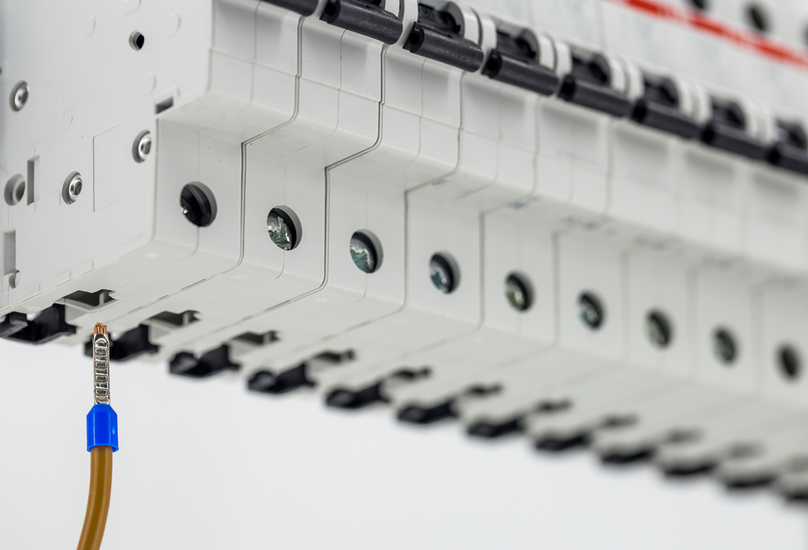
At its core, an RCBO is doing two jobs at once.
First, it constantly measures the current flowing in the live and neutral conductors. Under normal conditions, these currents are equal.
If there’s an imbalance, even a small one, say 30 milliamps, it suggests some of the current is escaping to earth. That could be through a person, damaged insulation, or water ingress.
The RCBO reacts by disconnecting the supply almost instantly, usually within 40 milliseconds.
Second, it watches for signs of overcurrent. If too many appliances are plugged in or a short circuit occurs, the thermal-magnetic trip inside the RCBO detects it.
In the case of an overload, the thermal element heats up and bends to trip the switch. For a short circuit, the magnetic part kicks in, reacting in a fraction of a second.
This dual vigilance means an RCBO is both a safety net for people and a guard dog for wiring.
Internal Components Of An RCBO
Inside the RCBO’s compact casing is an impressive bit of engineering:
- Core balance transformer – a small toroidal coil that both live and neutral conductors pass through. It’s the heart of the residual current detection.
- Trip coil/solenoid – energised when a fault is detected, triggering the trip mechanism.
- Thermal-magnetic trip unit – uses a bimetal strip for overloads and an electromagnetic coil for short circuits.
- Mechanical linkage – physically disconnects the contacts and latches them open until reset.
- Test button – introduces a deliberate imbalance to check the residual current detection still works.
It’s worth noting that the test button doesn’t check the overcurrent function – only the RCD part. For the full picture, proper electrical testing is needed during inspections.
Step-By-Step: How An RCBO Responds To A Fault
Let’s walk through a couple of scenarios.
1. Earth leakage fault
Say a kettle’s internal wiring has worn through, allowing current to flow to its metal case. If someone touches it, current flows through them to earth.
The RCBO detects that the live and neutral currents no longer match, and trips almost instantly, limiting the shock.
2. Overload
Imagine a kitchen ring circuit with the kettle, toaster, microwave, and heater all going at once. The current exceeds the circuit’s rating.
The thermal element in the RCBO gradually heats up and trips before the wiring can overheat.
3. Short circuit
A nail accidentally driven into a cable causes live and neutral to touch. The magnetic trip reacts immediately, disconnecting before damage can escalate.
In every case, the RCBO’s action is automatic and decisive.
Types Of RCBOs Available In The UK
Not all RCBOs are created equal. The “Type” refers to the kinds of residual currents they can detect:
- Type AC – standard sine-wave AC leakage currents.
- Type A – both AC and pulsed DC leakage (common in electronics, EV chargers).
- Type F – for appliances with mixed frequency components (variable-speed drives).
- Type B – covers AC, DC, and smooth DC currents (solar inverters, EV charging).
- Test button – introduces a deliberate imbalance to check the residual current detection still works.
Physical variations include:
- Single module – slimmer, space-saving.
- Two modules – older or more robust designs, sometimes with clearer separation of functions.
Choosing the right type matters – especially in modern installations with more electronic loads.
Testing And Maintenance
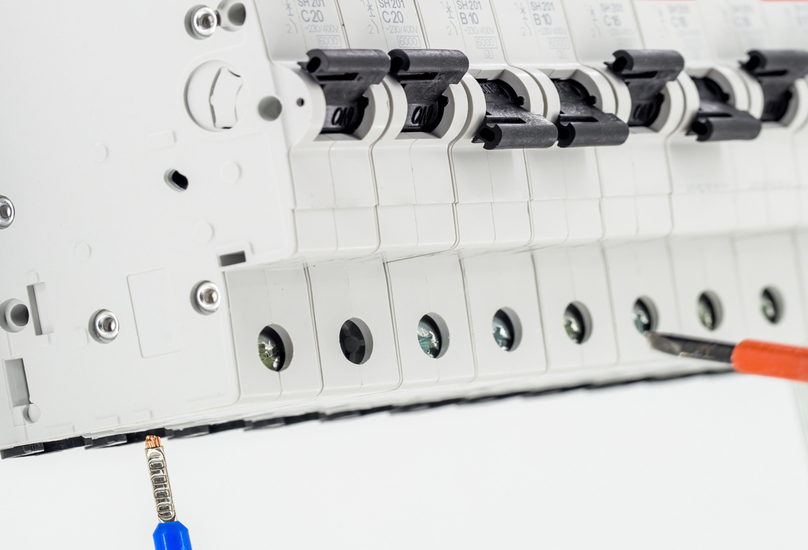
An RCBO isn’t a fit-and-forget device. Manufacturers recommend pressing the “Test” button once a month. It’s quick, it’s simple, and it proves the RCD section is working.
During an EICR (Electrical Installation Condition Report), electricians check RCBOs for trip times and mechanical condition.
False tripping can happen, often due to cumulative leakage currents from multiple appliances. If a circuit’s near the 30 mA limit, adding one more device might tip it over.
When an RCBO fails to reset or trips repeatedly without an obvious cause, replacement is the safe route.
Common Myths And Misunderstandings
- “An RCBO is the same as an RCD”, not quite. An RCBO does the RCD’s job and the MCB’s job.
- “One RCBO can protect the whole property”, possible in theory, but terrible for usability. One fault would black out everything.
- “RCBOs never go wrong.” They’re robust, but like any mechanical/electrical device, they can fail.
Practical Examples In UK Homes And Businesses
- Kitchen ring final – heavy load potential, plus water sources.
- Outdoor sockets – exposed to weather, high leakage risk.
- EV charger supply – DC leakage protection needed (often Type A or B RCBO).
- Workshop circuits – tools with motors, high starting currents.
Each case benefits from the individual protection an RCBO offers.
RCBOs Vs RCD + MCB: Which Should You Choose?
While RCBOs can be more expensive per circuit, they often save headaches. With separate MCB + RCD arrangements, one earth fault can kill multiple circuits. RCBOs isolate the problem instantly without dragging unrelated circuits down.
In tight consumer units, slimline RCBOs can also free up space, useful for future circuit additions.
Standards And Regulatory Context
RCBOs sold in the UK must meet BS EN 61009. Their use is guided by BS 7671, which specifies where residual current protection is required.
Domestic installers must also consider Part P of the Building Regulations, ensuring work is safe and compliant.
In tight consumer units, slimline RCBOs can also free up space, useful for future circuit additions.
Training And Simulation For Safe Practice
Working with RCBOs, especially diagnosing tripping issues, requires skill. It’s one thing to understand the theory, but another to work confidently in real installations.
That’s where tools like https://tradefoxapps.sitepreview.me come in. It’s a simulation platform designed for tradespeople, including electricians and plumbers, to practise and refine their skills without the danger of live circuits.
Final Thoughts
RCBOs are a practical evolution in electrical safety, compact, efficient, and aligned with modern regulations.
They protect people from shock, wiring from overload, and installations from the inconvenience of broad RCD tripping.
For electricians, they’re a tidy solution. For homeowners, it’s quite reassuring that the electrics are well-protected.
When selected, installed, and tested properly, an RCBO can run for years without drama, until the moment it’s needed, when it reacts without hesitation.