



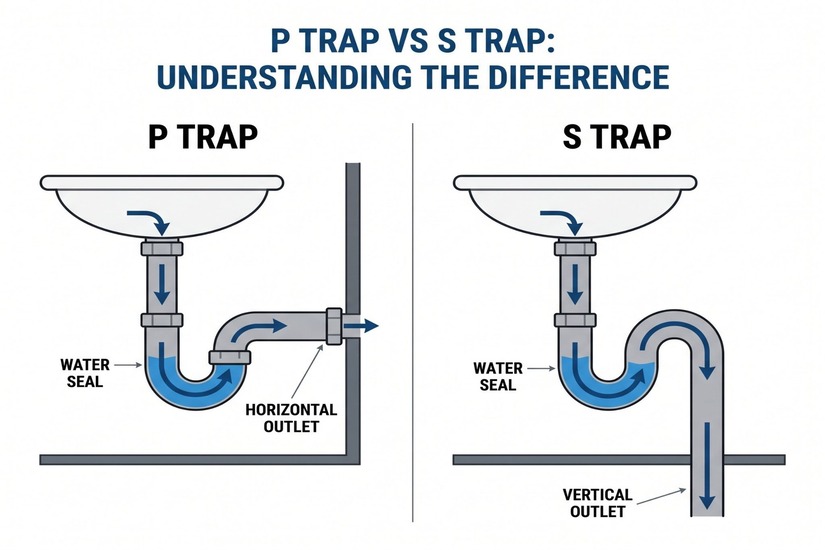
Ask any plumber the S trap vs P trap question and the honest answer starts with the outlet. On a P trap, waste leaves sideways into the branch pipe. On an S trap, it drops straight down into a vertical connection. That one detail decides where each shape fits on the wall or under the floor.
What it does not decide is whether the finished job holds its water seal or passes building control. Both shapes are stocked by every major UK manufacturer, in a range of seal depths and connection sizes. Picking the right one is less about the letter S or P and more about the appliance, the pipe run and the ventilation behind it.
The Core Difference: Where the Outlet Points
Think of the names as a quick sketch of the trap seen from the side. On a P trap, the water sits in the bend and the outlet runs out horizontally. On an S trap, the same bend holds the seal and the outlet carries on downward. Adjustable traps give you some room to move, as long as you stay inside the maker’s instructions.
| Fonctionnalité | P Trap | S Trap |
|---|---|---|
| Outlet direction | Sideways from the bend | Downwards from the bend |
| Usual connection | Branch running out to the wall |
Waste dropping below the appliance |
| Water seal | Held in the bend | Held in the bend |
| Seal depth | Set by the product you fit | Set by the product you fit |
| Siphon risk | Lower in most layouts | Higher if the drop runs full and unvented |
Does a P Trap Always Connect Through a Wall?
Not always. P traps often serve a branch heading to the wall, and S traps often drop below the basin or bath, but those are habits, not rules. Follow the whole waste route before you decide. The way the pipe leaves the trap does not tell you where it finally meets the stack or drain.
One more thing on the horizontal outlet: it is not an excuse to lay the branch dead level. The pipe still needs the fall that suits its diameter and load, or it will either hold water or pull the seal.
How a Trap Holds Its Water Seal
The bend keeps a plug of water after every discharge. That plug is the barrier that stops foul air from the drain coming back up through the appliance. Simple idea, and the whole reason you fit a trap at all.
The catch is that the seal has to survive real use, including other appliances firing on the same system. Traps can sit full of water on the bench and still lose part of the seal once pressure swings hit them. And seal depth is a fixed figure for the product. It is not the height of the trap body, the pipe size or the gap under the appliance.
Minimum Trap Sizes and Seal Depths in England
These are the baseline figures from Table 1 of England’s Approved Document H.
| Appliance | Minimum Trap Diameter | Minimum Water Seal Depth |
|---|---|---|
| Washbasin | 32 mm | 75 mm |
| Sink | 40 mm | 75 mm |
| Bath | 40 mm | 50 mm |
| Shower | 40 mm | 50 mm |
Several concessions apply alongside the table. Where a bath, shower or sink discharges straight into a gully, the seal can drop to 38 mm. Spray-tap basins with a flush-grated waste are also allowed a shallower seal, since they never take a plug or a full slug of water.
There is a separate figure people often mix up. Approved Document H asks every trap to keep at least 25 mm of seal under working and test conditions. That is the minimum left after pressure swings, not a licence to fit a 25 mm trap in place of a 50 mm or 75 mm one. Read the table and its footnotes together, or you will talk yourself into a trap that is too shallow.
Why the Figures Change Across the UK
Here is where plenty of online advice goes wrong. The England numbers are not UK numbers.
- Northern Ireland: Technical Booklet N sets a deeper 75 mm seal for baths and showers, not the 50 mm England allows. It only lets that fall to 40 mm for a ground-floor appliance discharging into an external gully.
- Scotland: The building standards point to BS EN 12056-2 for sanitary pipework under Standard 3.7, rather than a single national seal-depth table.
- Wales: Le Welsh Approved Document H keeps its own guidance and ties seal protection to the design of the branch discharge pipes.
| Nation | Guidance To Check |
|---|---|
| England | Approved Document H: Drainage and Waste Disposal |
| Wales | Welsh Approved Document H: Drainage and Waste Disposal |
| Scotland | Building Standards Technical Handbook, Standard 3.7 |
| Northern Ireland | Technical Booklet N: Drainage |
Always check the edition and any amendments that apply to the job. Advice built on an overseas plumbing code is not a UK rule, and it causes more argument on site than almost anything else.
What Causes Trap Seal Loss?
Blaming the outlet shape is the lazy diagnosis. Seal loss usually traces back to one of these:
- Self-Siphonage: The appliance's own discharge drags water out of its trap. This is the real reason S traps earned their reputation, since a full vertical drop can start siphoning.
- Induced Siphonage: A discharge elsewhere on the system drops the pressure and pulls on a neighbouring trap.
- Positive Pressure: Pressure building in the stack pushes back and, if it is strong enough, blows air through the seal.
- Evaporation: An appliance left unused slowly loses its water to the air.
- Leakage: A crack or a weeping joint in the bend lets the standing water drain away.
Faults above the waterline can leak during a discharge without ever emptying the standing seal, so where the defect lies matters as much as what it is. Good branch design and ventilation are what hold the seal steady against these swings. Saying every S trap siphons, or that a P trap never does, is simply wrong.
Are S Traps Banned in the UK?
No. That claim gets repeated a lot, and it is not true. UK manufacturers list S traps next to P traps for jobs that suit them.
Being on sale is not the same as being compliant in your particular layout, mind you. The trap still has to match the appliance, the required seal depth and the system it joins. An S trap on a short, unvented vertical drop is asking for self-siphonage, and that is a design problem rather than a ban.
S Trap vs P Trap: Choosing for the Appliance
This is where the S trap vs P trap choice gets made properly, appliance by appliance.
Washbasins and Kitchen Sinks
Start with the appliance waste, the seal depth you need and the branch route you have. P traps suit a connection heading back to the wall. S traps suit a drop straight down below the unit. Check the real dimensions, the joint type and the pipe sizes before you commit to either.
Where a sink trap also takes a washing machine or dishwasher, treat those connections as part of the design, and cap any spare inlet as the maker specifies. Cabinet space can steer how you route things, but it never overrides the seal the trap has to keep.
Baths and Showers
Tight clearance under a tray or a bath is the usual headache, so sort the trap, the appliance and the surrounding build together, early. Run through:
- Seal Depth: Confirm the trap meets the figure for your nation, 50 mm in England, 75 mm in Northern Ireland.
- Flow: Match the trap to the appliance and the water it will actually shift.
- Outlet Route: Leave a clean path for the waste pipe at the right fall.
- Access: Keep the cleaning or removal method reachable once tiling and panels go in.
Low-profile traps are fine only where their approved use and install conditions are met. Clearance on its own is not a reason to fit one. And never stack two traps in series to make up a seal depth, since that traps air between them and kills the flow.
WC Pans
The WC is a different animal. The pan has its own built-in seal, so an S-outlet or P-outlet pan is describing which way the pan discharges, not a separate trap under a basin. Specify the pan, the connector and the drain connection as one matched set, and leave basin-trap logic out of it.
Anti-Siphon Traps and Air Admittance Valves
These parts deal with negative pressure, and each has a clear limit worth knowing.
Valved Anti-Siphon Traps
Valved anti-siphon traps let air in when the pressure drops, then close once the surge passes. That protects the seal without a separate vent pipe. It will not fix undersized pipework or a leaking joint, so fit it for what it does and solve the rest on its own.
Air Admittance Valves
An air admittance valve, or AAV, works on the same one-way idea. It opens to admit air under negative pressure and shuts against positive pressure. Because it only ever lets air in, it cannot relieve positive pressure from the system, and it never replaces proper stack ventilation.
UK valves should meet BS EN 12380, and Approved Document H expects them to keep the below-ground ventilation the drain still relies on. Follow the maker’s rules on position, the right way up, air supply and access for servicing.
The Pipework Decides Performance Too
Even a sound trap fails on bad pipework. Give the branch the same attention as the fitting:
- Capacity: Size the branch for the appliances feeding it.
- Length and Fall: Use the limit for your layout, not one blanket figure.
- Direction Changes: Use swept fittings and keep the route sensible.
- Joints: Check that the pipe material and connection system match.
- Support: Hold the pipe without loading the trap or appliance.
- Ventilation: Plan for pressure control across the whole run.
- Access: Leave a real way to rod or remove parts later.
BS EN 12056-2 covers the layout and sizing of gravity sanitary pipework, and BS EN 274-1 sets the requirements for the waste fittings themselves. Product and system rules work together, but one does not stand in for the other.
Diagnosing Gurgles, Smells and Slow Drainage
Gurgling after another appliance drains points to pressure moving through the system. It does not name the faulty part on its own. Smells can come from a dried-out seal, a cracked trap, a bad joint or a fault further down the drain.
Swapping an S trap for a P trap before you know the cause often leaves the problem exactly where it was. Work out which layer is failing first:
- Local: Damage, a leak, a blockage or a poor appliance connection.
- Branch: Wrong size, wrong route or no allowance for pressure change.
- System: Shared stacks, ventilation or something downstream.
Before you open old waste pipework, treat the contents as a health risk and glove up. The HSE sets out the health hazards of working with sewage, and plumbers sit on its list of exposed workers.
Testing and Handover
Check connections while the appliance discharges, and watch how the system behaves when more than one outlet runs at once. The aim is simple: every appliance drains cleanly, and nothing pulls another trap’s seal while it does.
No visible drip does not prove the joints are airtight, so keep the discharge checks and the specified air test as two separate things. Record the trap and ventilation parts you fitted, and confirm the access still works once the room is finished.
On S trap vs P trap, the right call is the fitting that suits the outlet route while meeting the appliance, seal, ventilation, and access needs of the whole drainage design. Get those right, and the letter on the box barely matters.
A trap needs to work with the pipework around it. Build your plumbing knowledge with Tradefox’s interactive courses, using guided simulations and feedback to support your learning. Get started and work through lessons at your own pace.


