



Quick answer
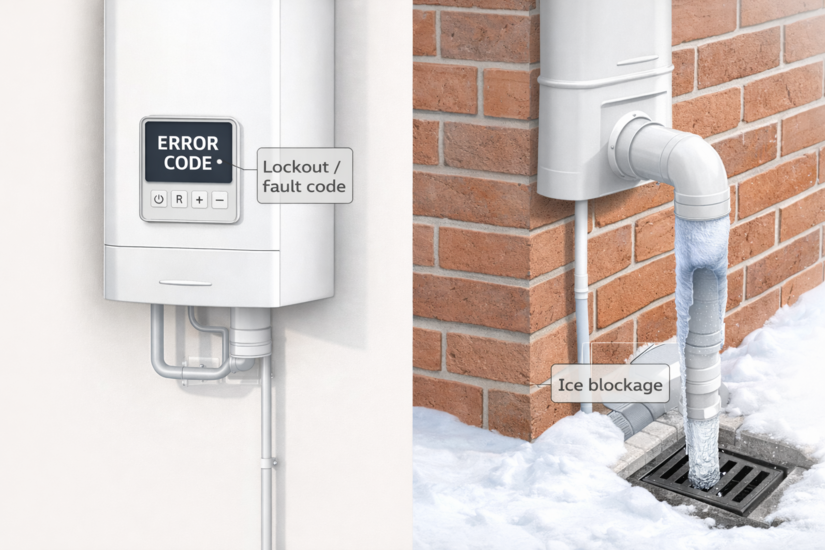
If your condensing boiler has stopped in freezing weather, is gurgling or shows a lockout code, the most likely cause is ice blocking the plastic condensate pipe where it runs outside. Thaw the frozen section with warm (never boiling) water, a hot water bottle or a microwaveable heat pack, then reset the boiler as your manual describes. If it still will not run, or the pipe keeps freezing, call a Gas Safe registered engineer.
A frozen condensate pipe is one of the most common UK winter boiler faults, and it is usually simpler to fix than it sounds. This guide covers how to recognise it, the codes the main manufacturers use, how to thaw it safely, and what an installer can do to stop it happening again.
What does a condensate pipe do?
A condensing boiler recovers extra heat from its flue gases. As those gases cool, water vapour condenses into a mildly acidic liquid called condensate, which collects in a trap inside the boiler and drains away through the condensate pipe.
The pipe is usually narrow white or light-grey plastic. It runs to an internal waste pipe or soil stack, or out through an external wall to a gully, drain or soakaway. Because the bore is small and the water trickles rather than flows, a small plug of ice is enough to block it.
For the part inside the boiler that feeds this pipe, see our guide to the boiler condensate trap, which covers trap types, servicing and the rules on discharge.
Why condensate pipes freeze
Freezing is most likely when temperatures stay below zero for long periods, especially overnight. The Heating and Hotwater Industry Council (HHIC) notes that prolonged cold snaps can reach around -20°C in parts of the UK, and that many existing pipes were not installed to current freeze-protection guidance.
When the pipe blocks, condensate backs up towards the boiler. The boiler detects this and shuts down or locks out to protect itself, which is why you lose heating and hot water exactly when you need them.
Where the pipe usually freezes
- The open end, where it discharges into a gully or drain and is most exposed to wind.
- Bends and elbows, where flow slows and insulation is often thinnest.
- Dips or sags in the run, where water sits instead of draining away.
- Long external runs, particularly on exposed walls.
- Unheated spaces such as garages or lofts, if the pipe passes through them.
How to tell if the condensate pipe is frozen
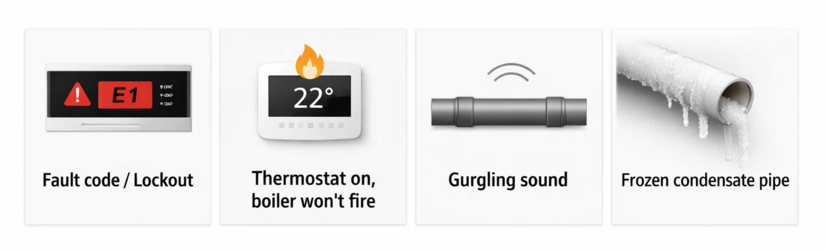
Look for a combination of these signs:
- The boiler will not fire, even though the thermostat is calling for heat.
- A fault code or lockout message is showing on the display.
- Gurgling or bubbling noises from the boiler or the pipe.
- Visible frost or ice on the external pipe, especially at the end.
- The boiler restarts after a reset but locks out again shortly afterwards.
A good rule of thumb: if the heating stopped during freezing weather and the outside section of pipe is iced up, the condensate pipe is the first thing to check.
Condensate-related fault codes by manufacturer
Codes vary by make and model, so always check your own user manual. The codes below are ones the manufacturers themselves link to a frozen or blocked condensate pipe. Several are general ignition or lockout codes, so they can have other causes too, such as a gas supply problem. For a wider list, see our guide to boiler error codes.
| Manufacturer | Code(s) | What the manufacturer says |
|---|---|---|
| Worcester Bosch | EA | Boilers with a digital display may show an EA code when the condensate pipe is frozen, often with a gurgling noise. |
| Vaillant | F.28 or F.29 | May mean the condensate pipe needs thawing. F.28 is an ignition failure code, and Vaillant also lists gas supply and ignition faults as causes. |
| Baxi | E133 or E28 | Shown on most Baxi boilers when the condensate pipe may be frozen. The display may alternate between “E1” and “33”. |
| Ideal (Logic Heat) | L2 | An ignition lockout. Ideal’s troubleshooting guide says to check first whether the condensate pipe is blocked. |
How to fix a frozen boiler condensate pipe safely
You can usually clear a frozen condensate pipe yourself, as long as it is reachable from ground level. Everything below happens outside the boiler: never remove the boiler casing.
1. Switch off and find the blockage
Switch the boiler off at its controls; Baxi also suggests turning off the power at the wall. Follow the pipe from where it leaves the wall to where it ends, looking for frost or ice. The blockage is usually at the end, at a bend or in a dip.
2. Apply gentle heat
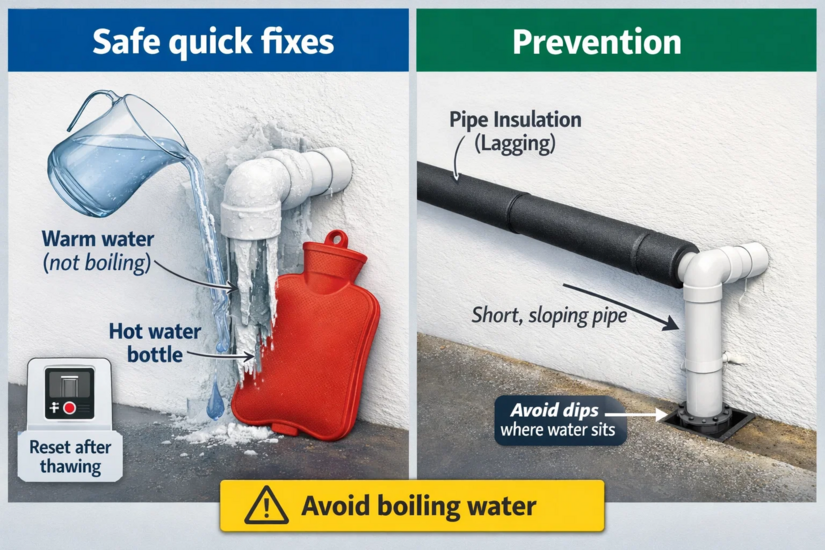
- Warm water: pour it from a watering can or jug along the frozen section, starting at the top and working down. A boiled kettle left to cool for 10 to 15 minutes is a sensible guide. Never use boiling water straight from the kettle, as it can crack the plastic pipe.
- Hot water bottle or heat pack: hold a hot water bottle, microwaveable heat pack or a cloth soaked in hot water against the frozen part. This is gentle on plastic and works well alongside warm water.
If the pipe is lagged, you may need to remove the insulation to get heat to it. Refit it afterwards so the pipe does not refreeze. Keep going until water runs freely from the end of the pipe.
3. Reset the boiler
Once the pipe is clear, the boiler will usually need a reset. This is normally a reset button on the front panel, or isolating and restoring the electrical supply. Follow your user manual or the manufacturer’s website.
If it locks out again straight away, the pipe may not be fully clear, so repeat the thawing. If it still will not run after a couple of attempts, stop and get professional help.
Stay safe while you do it
- Take care carrying hot water over icy ground, and wear sensible footwear.
- Poured water can refreeze on paths and create a slip hazard, so grit or sweep the area afterwards.
- If the pipe is high up or hard to reach, do not put yourself at risk. Call a professional.
Common mistakes to avoid
- Using boiling water, which can split the pipe and cause a leak.
- Resetting before the ice has cleared, then assuming there is a bigger fault.
- Focusing on the fault code and ignoring the ice outside. The code tells you the boiler has stopped; the ice tells you why.
- Forgetting to refit the lagging, so the pipe freezes again the same night.
How to prevent a frozen condensate pipe
Things you can do
- Check the lagging. External sections should be covered with waterproof, weatherproof insulation; replace lagging that is split, missing or waterlogged.
- Turn the boiler’s heating temperature up during a long cold snap, as Worcester Bosch and HHIC both suggest, then turn it back down afterwards. It costs a little efficiency but helps keep things running.
- Keep the heating on a timer or frost setting when you are away. Vaillant notes that an unused system is more likely to freeze.
- Ask your engineer to check the pipe’s fall, routing and insulation at the annual service.
Jobs for a competent installer
Changing how a condensate pipe is routed, sized or terminated is a job for a competent heating engineer, working to the manufacturer’s instructions and BS 6798:2014. Typical improvements include:
- Routing the pipe internally to a soil stack or waste pipe. HHIC, Vaillant and Worcester Bosch all describe this as the preferred option because it removes the external freezing risk. Where gravity drainage is not possible, a condensate pump can be used.
- Upsizing the external pipe. Where the pipe has to run outside, Worcester Bosch specifies a diameter of at least 32mm.
- Keeping the external run short and steep. Worcester Bosch recommends a continuous fall away from the boiler of at least 3°, no more than 3m outside, and as few bends as possible.
- Proper insulation. HHIC guidance published through IGEM calls for at least 13mm of UV-resistant, waterproof insulation on external pipe, with joints sealed.
- Better termination, such as ending the pipe below a drain cover, with an air break where needed, to limit wind chill.
- Trace heating: a heating element fitted along the pipe that switches on as temperatures approach freezing. Which? rates it as about the most dependable way to prevent freezing.
- Siphon traps, fitted to some boilers, release condensate in batches rather than a constant trickle, reducing freezing risk. Our condensate trap guide explains how they work.
When to call a Gas Safe engineer
Thawing the external pipe is a safe householder job; working on the boiler itself is not. Anyone employed to work on gas appliances in a home must be Gas Safe registered, and you can check an engineer online or on 0800 408 5500. Call one if:
- The boiler still will not run after thawing and a couple of resets.
- The pipe is out of reach, or you cannot find the frozen section.
- Water is leaking from the boiler or the pipe has cracked.
- The pipe freezes every winter and needs rerouting, upsizing or trace heating.
- The fault code points to something else, such as a gas supply or ignition fault.
If you smell gas, call the National Gas Emergency Service on 0800 111 999 (Great Britain, free, 24 hours) straight away; Northern Ireland has its own gas emergency line.
Frequently asked questions
Can I pour boiling water on a frozen condensate pipe?
No. Boiling water can crack the plastic pipe. Use warm water, such as a kettle left to cool for 10 to 15 minutes, or a hot water bottle or heat pack.
How do I know which pipe is the condensate pipe?
It is usually a white or light-grey plastic pipe that comes from the bottom of the boiler and leads to a drain, gully or internal waste pipe. It is not one of the copper pipes.
What error code does a frozen condensate pipe show?
It depends on the make: EA on Worcester Bosch, F.28 or F.29 on Vaillant, E133 or E28 on Baxi, and L2 on Ideal Logic Heat. These codes can have other causes, so check your manual.
Will a frozen condensate pipe damage my boiler?
Usually not. The boiler shuts down to stop condensate backing up. Once the pipe is thawed and the boiler reset, it should work normally.
Why does my condensate pipe keep freezing?
Repeated freezing usually points to the installation: a long external run, a narrow pipe, poor fall, sags, missing insulation or an exposed end. Ask a heating engineer to assess it and consider rerouting it inside.
Dernières réflexions
A frozen condensate pipe is one of the most common reasons a boiler stops in winter, and one of the easiest to put right. Learn the signs, thaw the pipe gently, never use boiling water, and reset the boiler as your manual describes. If it will not restart, or the problem keeps coming back, get a Gas Safe registered engineer to look at the boiler and the pipe run.
If you are training in the trade, Tradefox lets you practise diagnosing faults like this through realistic simulations before you meet them on a real job.